|
|
|

|
 How groups How groups
Intensify Decisions
|
|
Ψ Risky Shift Phenomenon: When people are in groups, they are likely to make riskier decisions. Perhaps the shared risk (diffusion of responsibility) makes the individual risk seem less. Theory discounted by later research.
• Group polarization effects have been demonstrated to exaggerate the inclinations of group members after a discussion. A military term for group polarization is "incestuous amplification".
Ψ Mechanisms of Polarization
• Normative influence: a.k.a. Social comparison: Power exerted on an individual by a reference group to conform to the group's (or generally accepted) norms of behavior.
• Informational influence: a.k.a. Persuasive Argument Theory, or PAT. PAT holds that individual choices are determined by individuals weighing remembered pro & con arguments. These arguments are then applied to possible choices, & the most positive is selected. As a mechanism for polarization, group discussion shifts the weight of evidence as each individual exposes their pro & con arguments, giving each other new arguments & increasing the stock of pro arguments in favor of the group tendency, & con arguments against the group tendency. The persuasiveness of an argument depends on two factors – originality & its validity. According to PAT, a valid argument would hold more persuasive weight than a non-valid one. Originality has come to be understood in terms of the novelty of an argument. A more novel argument would increase the likelihood that it is an addition to the other group members’ pool of pro & con arguments, rather than a simple repetition. Informational influence is the best supported explanation! Simply put: group discussion elicits a pooling of ideas, most of which favor the
dominant viewpoint.
Ψ Groupthink
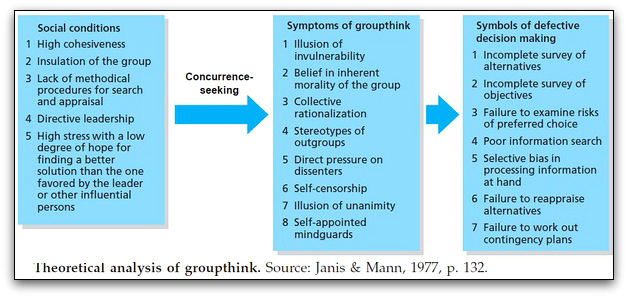
Eight Main Symptoms of Group Think
1. Illusion of Invulnerability: Members ignore obvious danger, take extreme risk, and are overly optimistic.
2. Collective Rationalization: Members discredit and explain away warning contrary to group thinking.
3. Illusion of Morality: Members believe their decisions are morally correct, ignoring the ethical consequences of their decisions.
4. Excessive Stereotyping: The group constructs negative sterotypes of rivals outside the group.
5. Pressure for Conformity: Members pressure any in the group who express arguments against the group's stereotypes, illusions, or commitments, viewing such opposition as disloyalty.
6. Self-Censorship: Members withhold their dissenting views and counter-arguments.
7. llusion of Unanimity: Members perceive falsely that everyone agrees with the group's decision; silence is seen as consent.
8. Mindguards: Some members appoint themselves to the role of protecting the group from adverse information that might threaten group complacency.
Avoiding Group Think
• The group should be made aware of the causes and consequences of group think.
• The leader should be neutral when assigning a decision-making task to a group, initially withholding all preferences and expectations. This practice will be especially effective if the leaders consistently encourages an atmosphere of open inquiry.
• The leader should give high priority to airing objections & doubts, and be accepting of criticism.
• Groups should always consider unpopular alternatives. Assign the role of devil's advocate to several strong members of the group!
• Sometimes it is useful to divide the group into two separate deliberative bodies as feasibilities are evaluated.
• Spend a sizable amount of time surveying all warning signals from rival group & organizations.
• After reaching a preliminary consensus on a decision, all residual doubts should be expressed & the matter reconsidered.
• Outside experts should be included in vital decision making.
• Tentative decisions should be discussed with trusted colleagues not in the decision-making group.
• The organization should routinely follow the administrative practice of establishing several independent decision-making groups to work on the same critical issue or policy.
Social Psychology
Robert C. Gates
|

|
|